.webp)
An Overdraft (OD) Facility is a flexible credit solution offered by banks and financial institutions that allows individuals and businesses to withdraw funds even when their account balance is insufficient. Unlike traditional loans that provide a lump sum amount, an overdraft facility gives borrowers access to a pre-approved credit limit that can be utilized whenever required. Interest is charged only on the amount used rather than the entire sanctioned limit, making it a cost-effective financing option for managing short-term financial requirements. In India, overdraft facilities are widely used by salaried individuals, self-employed professionals, business owners, and companies to address temporary cash flow gaps and unexpected expenses. Depending on eligibility, an overdraft can be secured against fixed deposits, property, shares, or other assets, while some lenders also offer unsecured overdraft facilities. At CNS Finserve, we help customers compare overdraft options from leading banks and financial institutions to secure the most suitable credit solution. With quick access to funds, flexible usage, and simplified repayment, an overdraft facility provides financial convenience while ensuring that important transactions and business operations continue without interruption.

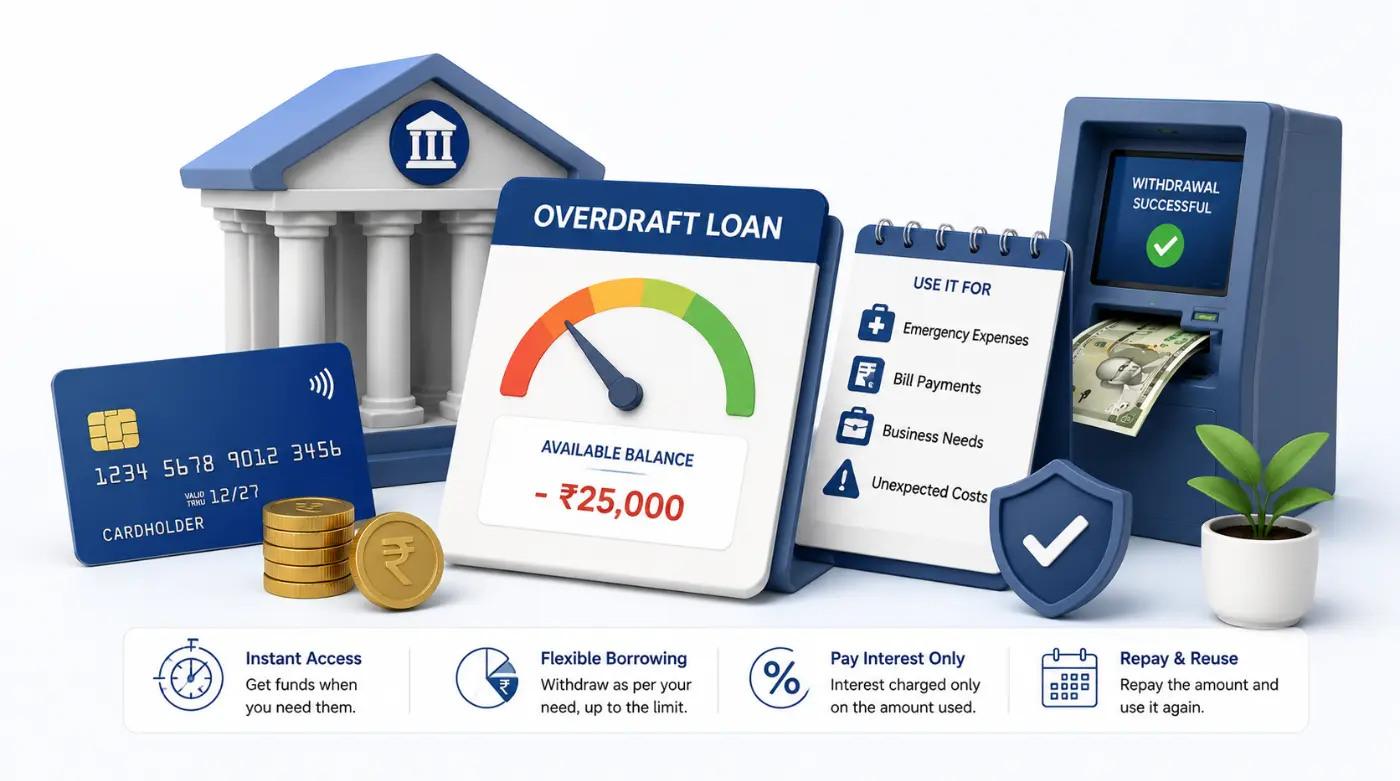
An overdraft facility functions as a revolving line of credit linked to a savings, salary, or current account. Once approved, borrowers can withdraw funds up to the sanctioned limit whenever required and repay the utilized amount as funds become available. Unlike term loans, there is generally no fixed EMI structure, providing greater flexibility for borrowers. Interest is calculated only on the outstanding amount used and for the duration it remains unpaid, making it an efficient borrowing option for short-term liquidity requirements. In India, overdraft facilities are commonly used to manage temporary cash shortages, meet emergency expenses, handle working capital requirements, pay suppliers, cover payroll obligations, and maintain smooth business operations. Businesses often rely on overdraft facilities to bridge the gap between receivables and payables, while individuals may use them for unforeseen financial situations. At CNS Finserve, we assist customers in identifying suitable overdraft solutions based on their income profile, business requirements, and collateral availability. With flexible repayment, immediate fund access, and lower borrowing costs on utilized amounts, an overdraft facility serves as a valuable financial tool for maintaining liquidity and financial stability without applying for a new loan every time funds are needed.
- Flexible Withdrawals
- Instant Access
- Pay As Used
- Revolving Credit
- Quick Approval
- Flexible Limit
An Overdraft Facility allows account holders to withdraw money beyond their available account balance up to a pre-approved limit. CNS Finserve helps customers compare overdraft options from leading banks and financial institutions.
Salaried individuals, self-employed professionals, business owners, and companies may be eligible for an overdraft facility based on their income, account history, and lender requirements. CNS Finserve assists applicants in identifying suitable overdraft solutions.
No. Interest is generally charged only on the amount utilized and for the period it remains outstanding. CNS Finserve helps borrowers understand the cost structure before choosing an overdraft facility.
Yes. Many banks offer overdraft facilities against Fixed Deposits (FDs), often at attractive interest rates. CNS Finserve can help you compare available options and secure the most beneficial terms.
Typical requirements include PAN Card, Aadhaar Card, bank statements, income proof, and collateral-related documents if applicable. CNS Finserve provides complete guidance throughout the documentation process.
An overdraft provides flexible access to funds up to a sanctioned limit with interest charged only on the amount used, whereas a personal loan is disbursed as a lump sum with fixed EMIs. CNS Finserve helps borrowers choose the most suitable financing option.